How to Stop Burning Through Air and Energy While Snorkeling
Quick Answer: Snorkeling fatigue comes from four correctable sources: an inefficient kick that uses the knees instead of the hips, a head position that raises drag and forces the arms to work, shallow rapid breathing through a tube with dead air space, and poor buoyancy management that makes you fight to stay level. Fixing breathing and body position alone typically doubles comfortable session length.
You get in, it’s beautiful, and forty minutes later you’re winded, your calves are cramping, and you’re heading back well before you wanted to. The people who stay out for two hours aren’t fitter than you. They’re doing four specific things differently.
Why does snorkeling tire people out faster than swimming?
It’s usually not effort — it’s inefficiency, and it comes from treating a floating activity like a swimming one.
When you swim, the goal is to move forward at speed. Body position, kick, and breathing are all optimized around propulsion, and you rest between efforts. Snorkeling has no rest intervals. You’re in the water continuously, often for an hour or more, and small inefficiencies compound relentlessly across that time.
The biggest of those is drag. Water is roughly 800 times denser than air, so a body position that raises your torso even slightly out of a horizontal line adds substantial resistance. You then work harder to overcome it, breathe harder, and tire faster — and the fatigue itself degrades your position further, which is a loop.
The second is breathing mechanics. A snorkel adds dead air space — the volume of the tube itself, typically 150 to 250 ml. Every breath, you re-inhale that volume of your own exhaled air before fresh air reaches you. With slow, deep breaths this is trivial. With fast shallow breaths, a meaningful fraction of every breath is recycled CO2, and rising CO2 is what produces the urgent breathless feeling long before oxygen is actually a problem.
That’s the mechanism behind the most common snorkeling experience: feeling out of breath while doing almost nothing.
The third is cold. Even in 80°F water, you’re losing heat roughly 25 times faster than in air of the same temperature. Over an hour, that’s a real metabolic cost that people consistently underestimate, and it’s why the last twenty minutes of a session always feel harder than the first twenty.
And the fourth is simply kicking too much. New snorkelers kick almost continuously. Experienced ones glide, kick two or three times, and glide again. Over an hour that difference is enormous.
How should you actually breathe through a snorkel?
Slowly, deeply, and with a deliberate pause — the opposite of what feels natural when your face is in water.
The target is roughly 6 to 8 breaths per minute, which will feel absurdly slow at first. Each breath should be a full, unhurried inhale over about three seconds, and an exhale over about four to five seconds. The longer exhale matters, because it’s what clears the tube’s dead space.
Here’s why the exhale is the critical half. If you exhale weakly, the last portion of your exhaled breath sits in the tube. Your next inhale draws that CO2-rich air back in first. Do that repeatedly and CO2 builds steadily, producing the breathless, slightly panicky sensation that sends people back to the boat.
A strong, complete exhale flushes the tube properly. It costs nothing and it’s the single most effective change most snorkelers can make.
Breathe through your mouth only. Nose breathing into a mask fogs it and slowly floods it with exhaled moisture. Many people unconsciously nose-breathe when relaxed, then fight a fogging mask for the whole session without connecting the two.
The second technique worth learning is what free divers call a relaxation breath cycle: before you start, float still on the surface for 60 to 90 seconds breathing slowly and doing nothing at all. This lowers heart rate, resets breathing rhythm, and sets the pace for the whole session. People who skip it tend to start elevated and never come down.
One more: if you feel breathless, stop kicking entirely and float. The urge to swim toward calm is strong and wrong. Stillness plus three long exhales resolves the sensation within about thirty seconds, because it’s CO2 driven rather than oxygen driven.
What does correct body position look like?
Flat, long, and lower in the water than instinct suggests.
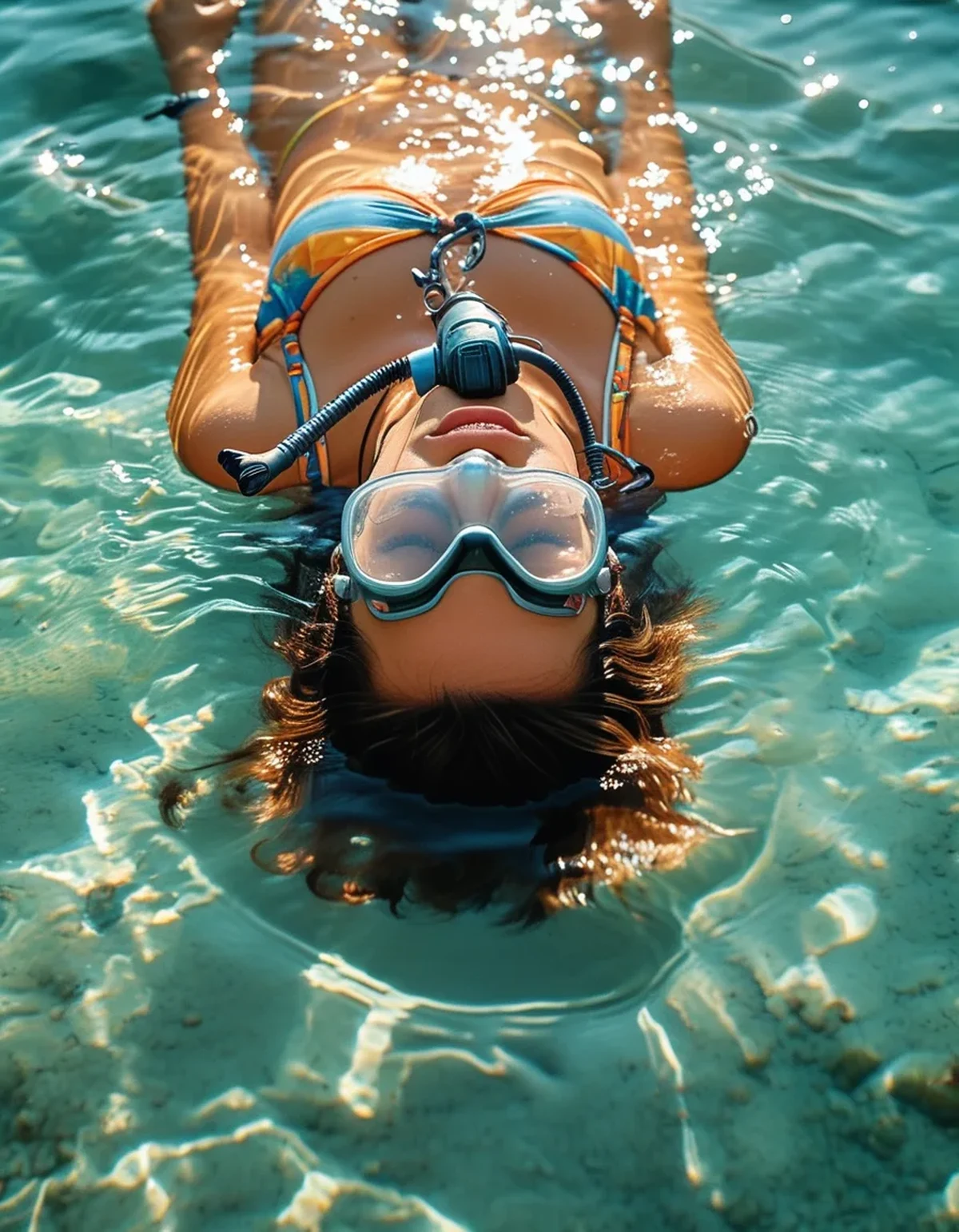
The efficient position is horizontal from head to heel, with your face down and looking at the bottom rather than forward, hips at the surface, and legs extended behind you. From the side, you should be a straight line.
What most people do instead is look forward. Lifting your head to see ahead drops your hips, angles your body, and turns you from a torpedo into a plough. The drag penalty is substantial, and it also strains the neck over an hour.
The fix is to look down, and turn your whole body to change direction rather than lifting your head. You’ll see less ahead of you, which feels wrong for about ten minutes and then stops mattering — most of what you want to see is below you anyway.
Arms belong at your sides, not out front and not sculling. Arms out front add frontal drag and do almost nothing propulsively with fins on. Tucking them along your body reduces drag noticeably and lets you relax the shoulders, which also reduces the tension that drives fast breathing.
Hips at the surface is the piece people struggle with. If your legs sink, you’re either lifting your head, holding too much air in your lungs, or wearing insufficient exposure protection for the water temperature. All three are addressable — and a wetsuit or rashguard changes buoyancy meaningfully, which is why the same person floats differently on different trips.
A useful self-check: if you can feel water moving across the backs of your calves as you kick, your legs are at the surface. If you can’t, they’re too deep and you’re dragging them through the water column.
What’s wrong with how most people kick?
The knee. Almost universally, the knee.
A snorkeling or diving kick comes from the hip, with a relatively straight leg and a soft, relaxed knee. The fin does the work; your leg just moves it. The motion should be slow and long — think of the whole leg as one lever pivoting at the hip.
What new snorkelers do is a bicycle-style kick from the knee, which is what you’d use to tread water. This is dramatically less efficient with fins. It generates turbulence rather than thrust, uses the quadriceps and calves heavily, and is the direct cause of the calf cramps that end so many sessions.
Slow and long beats fast and short, always. A slow kick cycle — roughly one complete cycle every two to three seconds — moves you as fast as a rapid one with a fraction of the energy cost, because fin thrust depends on the surface area moving through water rather than the frequency.
Point your toes. A flexed ankle turns the fin into a brake on the recovery stroke. Relaxed, pointed feet let the fin blade flex and load properly.
Kick in bursts, then glide. Three to five kicks, then stop entirely and drift. You’ll be surprised how far a good body position carries you. This intermittent pattern is what separates a forty-minute session from a two-hour one, and it’s also what lets you actually look at things rather than swimming past them.
And about cramps: calf cramping in snorkeling is usually a combination of knee-driven kicking, ill-fitting fins that require toe-gripping to stay on, cold, and dehydration. All four are worth addressing, but the kick is the biggest lever.
How much does gear choice actually matter?
Less than technique, but more than nothing — and a few specific items matter a lot.
Fin fit is the one that genuinely changes fatigue. Fins that are slightly loose require you to grip with your toes continuously to keep them on, which is a direct route to arch and calf cramps. Fins that are too tight restrict circulation and cause the same. Full-foot fins should feel like a snug shoe; open-heel fins over booties should have no heel lift at all.
Fin stiffness should match your leg strength and your intended use. Long, stiff blades reward strong slow kicks and punish weak fast ones. For general snorkeling, a medium-length, medium-stiffness fin is more efficient for most people than a long free diving blade.
Mask fit matters for a different reason. A leaking mask means constant clearing, constant low-level irritation, and elevated breathing rate from the mild stress of it. Test fit by placing the mask on your face without the strap and inhaling gently through your nose — it should seal and hold on its own.
A snorkel with a purge valve and a splash guard reduces the work of clearing water. Dry-top snorkels prevent flooding entirely but add bulk and drag; it’s a genuine tradeoff rather than a strict upgrade.
Exposure protection is underrated. A thin rashguard or shorty wetsuit in 78 to 82°F water extends comfortable session time substantially, both by reducing heat loss and by adding buoyancy that helps you hold position without effort.
What matters less than the marketing suggests: expensive lenses, elaborate snorkel designs, and anything sold on the basis of hydrodynamics for an activity conducted at under one mile per hour.
How do you build the endurance for longer sessions?
Mostly by removing work rather than adding fitness, though both help.
Start with a deliberate practice session in calm shallow water. Spend twenty minutes doing nothing but breathing slowly and holding position. It’s boring and it’s the fastest way to internalize the pace. Most people have never once practiced snorkeling as a skill — they’ve only ever done it on vacation, in interesting water, with no attention to technique.
Then add the glide-kick-glide rhythm consciously for a session. Count it if you need to: five kicks, ten seconds of drift. It feels lazy and it covers ground surprisingly well.
On the fitness side, what transfers best is hip-driven kicking practice — a kickboard session with fins, focused on straight-leg kicking from the hip, twice a week for a few weeks. This builds the specific motor pattern and the hip flexor and glute endurance it requires, which is different from general leg fitness.
Hydrate before and after. Immersion causes a diuretic response — your body shifts blood centrally in the water and offloads fluid — so you dehydrate faster than you’d expect while surrounded by water. Dehydration contributes directly to cramping.
Get out before you’re tired, especially early on. Ending a session with energy left builds the habit and the confidence that make longer sessions possible. Pushing to exhaustion in open water is also a genuine safety issue rather than a training strategy.
A note on safety, because it belongs here: snorkel with a buddy, know the current and tide before entering, stay within your ability to return against wind and current, and never hyperventilate before breath-hold diving — it suppresses the CO2 urge to breathe without adding oxygen and is a recognized cause of shallow water blackout. This is general information, not instruction; if you plan to free dive at all, take a proper course.
FAQ: Efficient Snorkeling Questions, Answered
How long should a comfortable session be?
With reasonable technique and appropriate exposure protection, 60 to 120 minutes is a normal range for a recreational snorkeler in warm water. If you’re ending at 30 to 40 minutes consistently and it’s fatigue rather than boredom, technique is almost certainly the limiter.
Why do I feel breathless when I’m barely moving?
CO2 accumulation from shallow rapid breathing through the tube’s dead space. Stop kicking, float still, and take three long complete exhales. It typically resolves within thirty seconds, which is itself diagnostic — an oxygen problem wouldn’t.
Are my fins the problem or my kick?
Test it: swim 25 yards with a deliberately slow, straight-leg, hip-driven kick and see whether it feels easier than your normal pace. If it does, it’s technique. If your fins slip or you’re gripping with your toes to keep them on, it’s fit — and that’s worth fixing before anything else.
Does snorkeling in cooler water change the approach?
Yes, substantially. Below about 75°F, heat loss becomes the limiting factor rather than technique, and the answer is exposure protection rather than effort. A 3mm wetsuit changes a 30-minute session into a 90-minute one more reliably than any technique change will.
TL;DR:
- Fatigue comes from drag, CO2 buildup, knee-driven kicking, and heat loss — not from lack of fitness.
- Breathe 6 to 8 times a minute with long complete exhales to flush the tube’s dead space.
- Look down, arms at your sides, hips at the surface; turn your body, not your head.
- Kick from the hip, slowly, in bursts of three to five, then glide.
- Fin fit and exposure protection do more for session length than any other gear.
The two-hour snorkelers aren’t working harder than you — they’re working considerably less. Almost every technique change here reduces effort rather than adding it, which makes this one of the rare skills where getting better feels easier rather than harder. Spend one deliberate session on breathing and body position in calm water, and the next real one will be a different activity.
Keep Reading
This article is for general informational and styling purposes only. Fit, sizing, and product availability may vary.