The Complete Guide to Snorkelling When the Visibility Is Poor
Quick Answer: Poor visibility is a navigation and safety problem before it is an enjoyment problem. Stay shallower, stay closer to a fixed reference like a shoreline or a rope, snorkel with a partner within arm’s reach, and change what you are looking for - low visibility rewards close-range observation of small things far more than open-water swimming. Never snorkel in visibility under about a metre without a surface marker and a buddy.
The forecast was fine. The water is not.
There was rain two days ago, an autumn storm stirred the bottom, and what should have been fifteen metres of visibility is closer to three. You can either go home or you can snorkel differently.
The second option is genuinely worth taking, and it needs a different plan rather than a more determined version of the usual one.
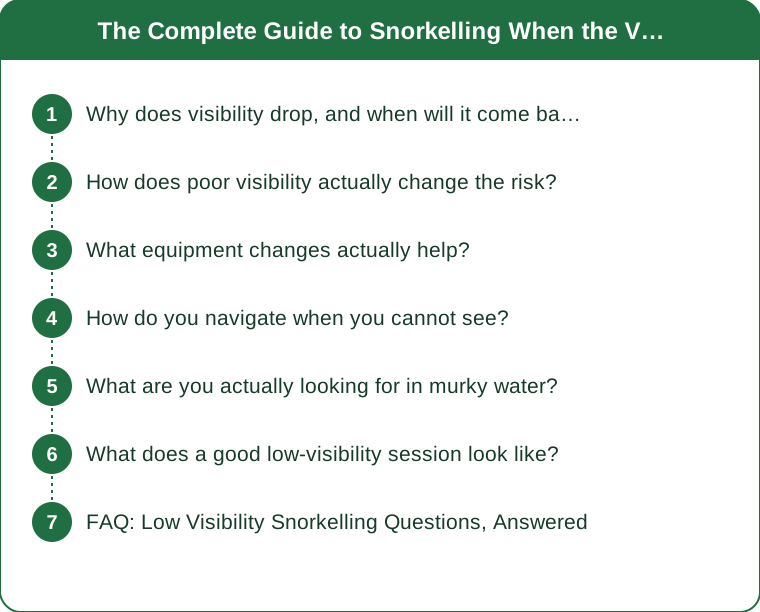
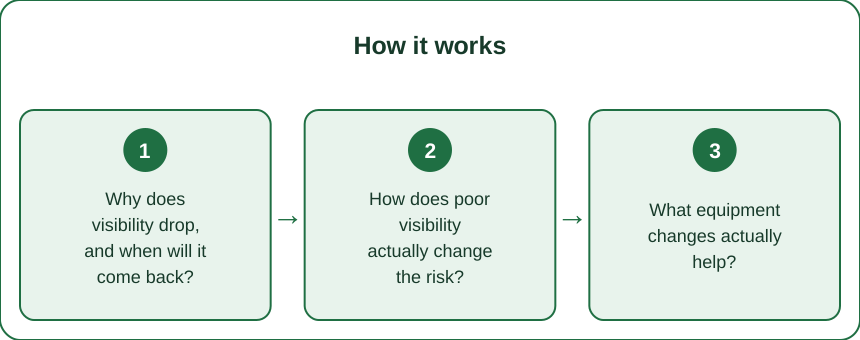
Why does visibility drop, and when will it come back?
Three separate causes, and knowing which one you are dealing with tells you whether to wait an hour or come back next week.
Suspended sediment is the most common. Wind, waves, rain runoff, or a storm swell lifts fine particles off the bottom and holds them in the water column. In a sheltered bay with a sandy bottom this settles within twelve to twenty-four hours of the water going flat. In a silty estuary it can take days. Rivers dumping runoff after heavy rain can keep an entire coastline murky for the better part of a week.
Plankton blooms are the seasonal one, and autumn is a common time for them. As surface water cools it mixes with deeper nutrient-rich water and phytoplankton multiplies. The water goes green rather than brown, and visibility can drop to a few metres over a large area. Blooms last weeks and there is no waiting them out on a given day.
Thermoclines and haloclines produce a different effect - a shimmering, oily-looking blur at the boundary between two layers of different temperature or salinity. Visibility above and below the boundary may be excellent while the boundary itself is unreadable. These usually sit at a specific depth, which means you can simply stay above them.
The practical test on arrival: look at the colour. Brown means sediment and it may improve within a day. Green means plankton and it will not. A shimmer at depth with clear water above means a thermocline, and you can work around it.
One safety note that applies to the first category specifically: heavy rain runoff carries whatever was on the land into the water, and bacterial levels rise sharply after storms. Many coastal areas advise against swimming for 24 to 48 hours after heavy rainfall for that reason. Check local advice rather than judging by appearance.
How does poor visibility actually change the risk?
It changes it more than most people account for, and the risks it raises are not the ones people expect.
Losing your buddy is the primary one. In clear water you can be twenty metres apart and completely aware of each other. In three-metre visibility, twenty metres apart means alone. The distance at which you lose contact is exactly the visibility distance, and separation happens far faster than anyone expects because both people are looking down.
Losing your position relative to the shore is the second. Without a visible bottom feature or a shoreline in view, it is remarkably easy to drift. Currents that are trivial in clear water become significant when you cannot tell you are moving. People have surfaced from a twenty-minute murky snorkel several hundred metres from where they expected to be.
Boat traffic is the third and the most serious. If you cannot see far, boats cannot see you either, and a snorkeller flat on the surface in choppy grey water is close to invisible. This is the single strongest argument for a surface marker buoy, and in low visibility it stops being optional.
Entanglement and obstacles round it out. Fishing line, nets, submerged branches, and rocks all arrive with much less warning. Moving slowly is not just about comfort here.
What does not increase much: the wildlife risk. The animals can see and hear you far better than you can see them, and low visibility does not change their behaviour toward you in any meaningful way.
The overall picture is that low-visibility snorkelling is fine with the right structure and genuinely unwise without it. The structure is: buddy within arm’s reach, a fixed reference you can see, a surface marker, and a shorter session than you would normally plan.
What equipment changes actually help?
Some standard kit becomes much more useful and some becomes actively unhelpful.
A surface marker buoy on a short line is the single most valuable item. It makes you visible to boats, gives your buddy something to find, and lets you keep track of your own position when there is nothing else to reference. In poor visibility, treat it as mandatory rather than optional.
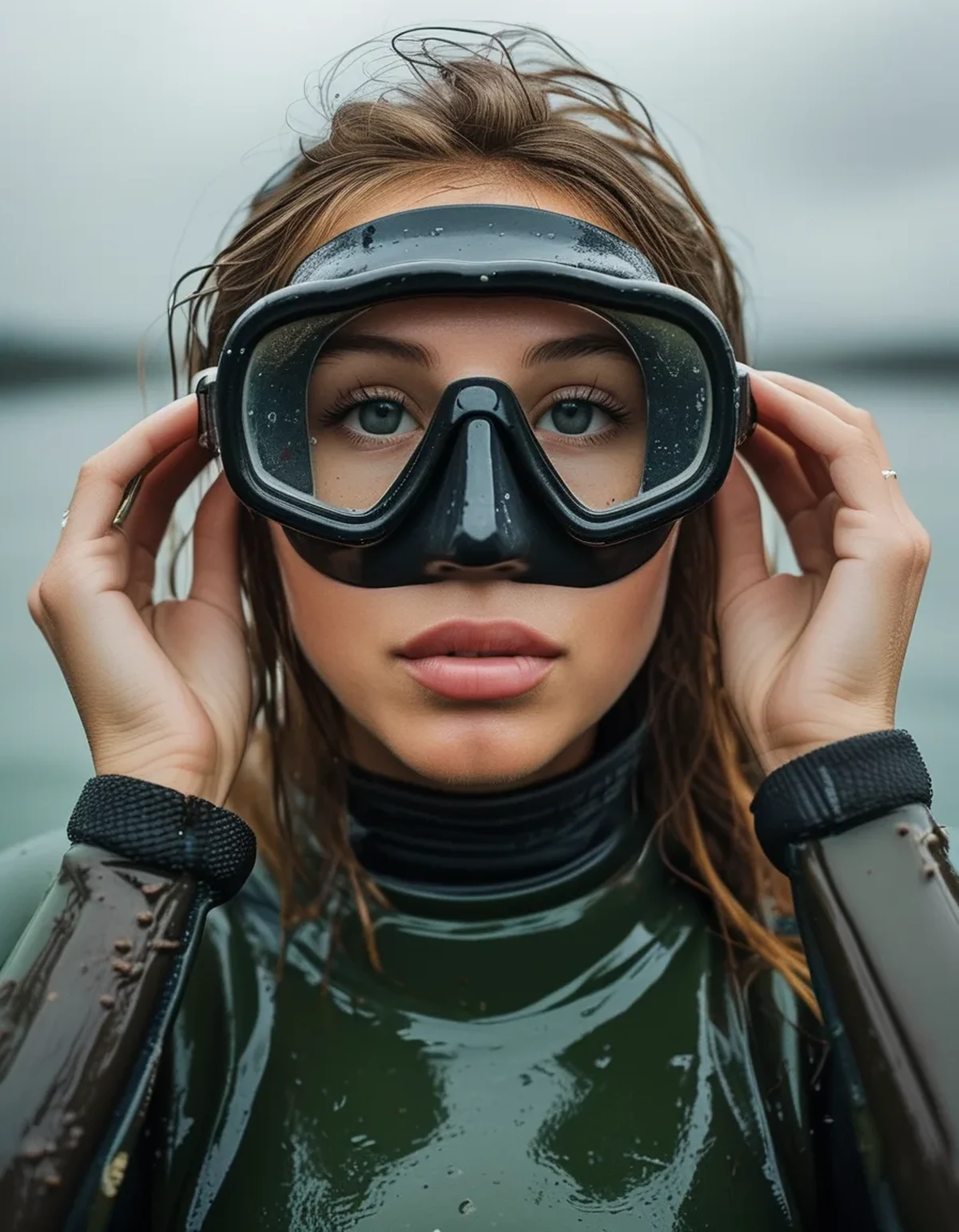
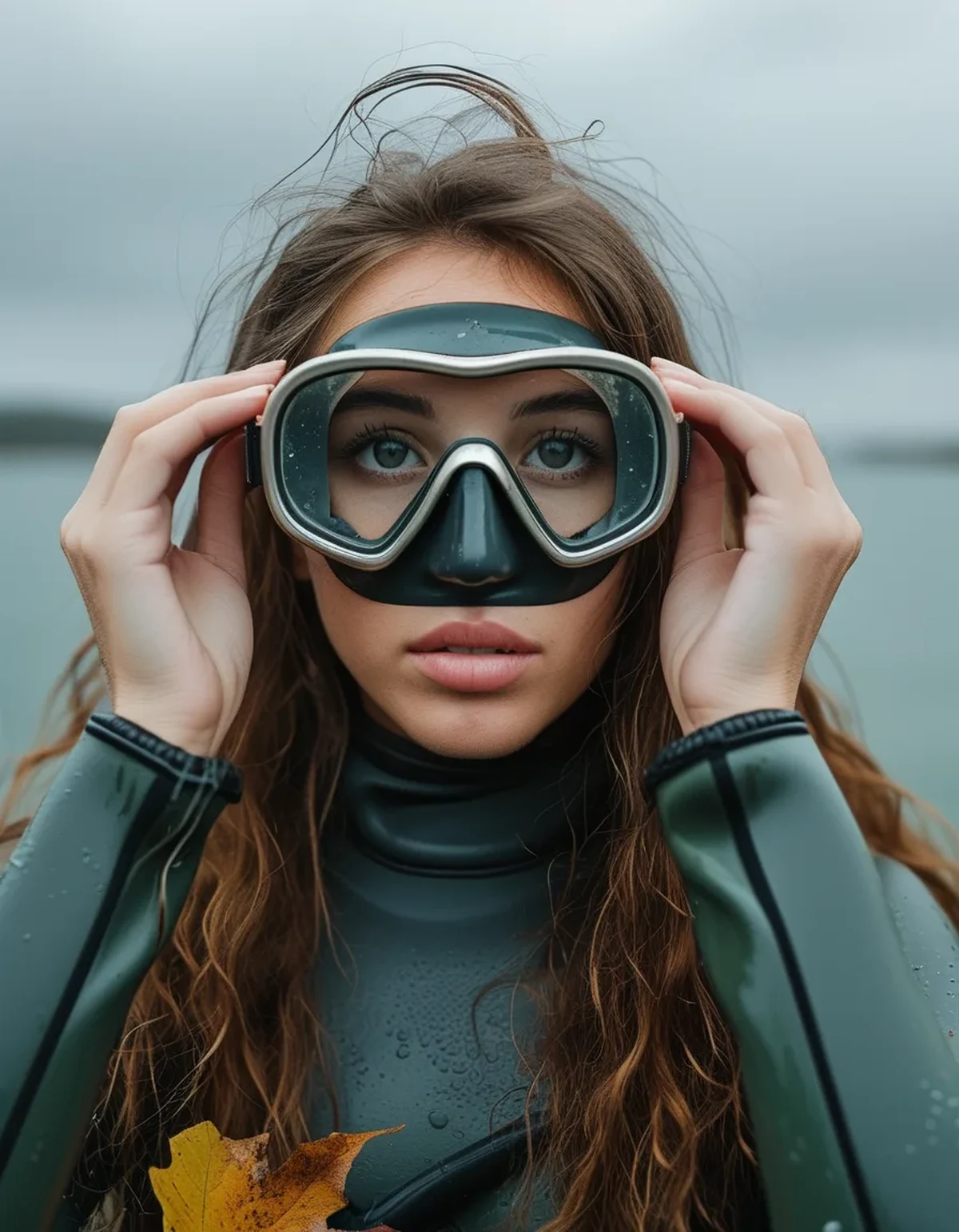
A low-volume mask with the widest field of view you can get. When your visible range is short, peripheral vision is doing far more work. A mask with a narrow frame or heavy side supports costs you awareness that you cannot spare.
Skip the coloured lens. Amber and yellow lenses are marketed for low light and they do help in dull conditions. In sediment-laden water they increase contrast in a way that can make the murk itself more visible, which is the opposite of useful. Clear glass is the better default.
A torch is more useful than you would think and needs the right beam. A wide, diffuse beam lights up the particles between you and the subject and makes things worse - the same reason full-beam headlights fail in fog. A narrow, focused beam pointed at something close works well. Bring one with a tight spot, and expect to use it at arm’s length rather than as a searchlight.
Fins matter less; a wetsuit matters more. Low visibility usually arrives with autumn conditions, and you will be moving slowly rather than swimming hard, which means you will get cold much faster than an equivalent summer session. Wear more neoprene than the water temperature alone suggests.
Bright fins, bright cap, bright everything. For your buddy’s sake. A black wetsuit with black fins in green water disappears at two metres.
How do you navigate when you cannot see?
You do not navigate by looking around, because looking around is exactly what does not work. You navigate by staying attached to something.
Follow a fixed line. A shoreline, a reef edge, a rocky wall, a sandbank, a pier. Keep it on the same side for the whole outbound leg and on the other side for the return. This is the single most reliable method and it needs no equipment.
Work in a depth contour. If you cannot see the shore, you can still see the bottom, and following a constant depth is a form of navigation. Swim keeping the bottom at the same apparent distance and you are following the contour, which will parallel the shore in most places.
Use a compass if you have one. A basic wrist compass costs very little and turns an out-and-back into a solved problem. Take a bearing from the entry point, swim it out, reverse it coming back.
Set a time limit and reverse on it, not on how you feel. Twenty minutes out, turn, twenty minutes back. Feeling is unreliable when there is nothing to reference, and current makes the outbound leg easier and shorter-feeling than the return will be.
Surface and check every few minutes. More often than you would in clear water. Look for your entry landmark, look for your buddy, look for boats. This is the habit that prevents the several-hundred-metre surprise.
And choose the site for the conditions. A sheltered bay with a rocky edge on one side is an excellent low-visibility site. An open sandy beach with nothing to reference is a poor one regardless of how good it is on a clear day.
What are you actually looking for in murky water?
This is the part that turns a salvaged session into a good one, and it requires genuinely changing your expectations rather than lowering them.
Clear-water snorkelling is a wide-angle activity. You scan, you spot something interesting twenty metres away, you swim to it. None of that is available.
Low-visibility snorkelling is a close-range activity, and close range is where most of the actual biology is. A square metre of rocky bottom examined properly for five minutes contains more than a hundred metres of open-water swimming does, and it is the kind of looking that clear water actively discourages because there is always something more distant to go and see.
Work rock edges and structure. Anywhere the bottom changes - rock to sand, weed to rock, the base of a pier piling - concentrates life. In poor visibility you can only see what is close, so go where close is interesting.
Slow down to about a quarter of your normal speed. Most small marine life is either camouflaged or motionless, and both defeat a moving observer. Hanging still above one patch for two minutes reveals things that swimming over it never will.
Get closer than feels normal. Thirty centimetres from a rock face is a completely different experience from a metre, and in murky water it is the only distance that works properly.
Bring the torch and use it at short range. A tight beam on a rock crevice at arm’s length shows colours that are entirely absent in ambient green light. Reds and oranges disappear first as light is absorbed, so a torch at close range is genuinely revealing rather than merely brighter.
And take a camera if you have one, set for macro. Wide shots are hopeless in murk and close-ups are barely affected by it, because there is almost no water between the lens and the subject.
What does a good low-visibility session look like?
Concretely, from arrival to exit.
On arrival, assess before you commit. Wade in to knee depth and look down. If you can clearly see your feet, you have at least a metre and probably more. If you cannot, the session is a shallow shoreline crawl or nothing at all.
Brief the buddy properly and set the contact rule. Within arm’s reach, not within sight. Agree what happens if you separate - the standard is that both surface immediately, and if you do not find each other within one minute, both return to the entry point. Agree it out loud rather than assuming.
Enter at a landmark you can identify from the water. A specific rock, a set of steps, a distinctive tree. A stretch of identical beach is not a landmark.
Stay shallow. One to three metres. It is brighter, it is nearer help, it is where the structure is, and it is where the interesting close-range life lives anyway.
Plan a shorter session. Thirty to forty minutes rather than ninety. You will be colder than you expect and more mentally tired, because low visibility requires continuous attention in a way clear water does not.
Exit before you are cold rather than when you are. Cold degrades judgement before it degrades comfort, and low visibility is the wrong condition to be making degraded judgements in.
And if the answer on arrival is that the water is too murky to be safe or enjoyable, going home is a legitimate outcome. The best low-visibility snorkellers are the ones who are relaxed about calling it, which is what lets them be relaxed about going in on the days that are merely mediocre.
FAQ: Low Visibility Snorkelling Questions, Answered
How murky is too murky?
A reasonable personal rule is that if you cannot see your own fins clearly while floating on the surface, you should not be going more than a few metres from shore. Under about a metre of visibility, most people should stay in standing depth or not go at all.
Does the visibility improve further out?
Often yes, if the cause is river runoff or shoreline sediment - the murk is a nearshore band and clears offshore. That is a poor reason to swim out, though, since you would be crossing the worst visibility to get there and back.
Is autumn always bad for visibility?
No, and this surprises people. Early autumn frequently has the best visibility of the year in temperate waters - the summer plankton has died back, the water is still warm, and the winter storms have not started. The bad conditions are storm-driven and short-lived rather than a property of the season.
Should I snorkel alone in poor visibility?
No. This is the condition where the buddy system stops being good practice and becomes the main safety mechanism you have. If you have no buddy, stay in standing depth.
TL;DR:
- Brown water means sediment and may clear in a day; green means plankton and will not. Check local advice after heavy rain.
- The real risks are buddy separation, drift, and boat traffic - a surface marker buoy stops being optional.
- Navigate by staying attached to a shoreline, a reef edge, or a depth contour, and reverse on a timer rather than a feeling.
- Change what you are looking for: work structure at close range, slow to a quarter speed, and use a tight torch beam at arm’s length.
- Stay shallow, plan a shorter session, and treat going home as a legitimate outcome.
Poor visibility is not a ruined session. It is a different activity that happens to use the same kit - and it rewards the kind of close, patient looking that clear water constantly tempts you away from.
Keep Reading
This article is for general informational and styling purposes only. Fit, sizing, and product availability may vary.