The Complete Guide to Snorkelling as the Water Cools Into Autumn
Quick Answer: Autumn water is often clearer and more interesting than summer water, but it demands thermal protection, shorter sessions and much more conservative judgement about conditions. The key changes: a wetsuit appropriate to the actual water temperature rather than the air temperature, a hood or neoprene cap since a large share of heat is lost through the head, shorter sessions with warm layers ready on the beach, and a hard rule about not entering when swell or wind has increased. Cold water incapacitates faster than most people expect.
The water in September is often clearer than it was all summer, and there is nobody in it.
It is also several degrees colder than the last time you swam, and the air above it lies to you about that.
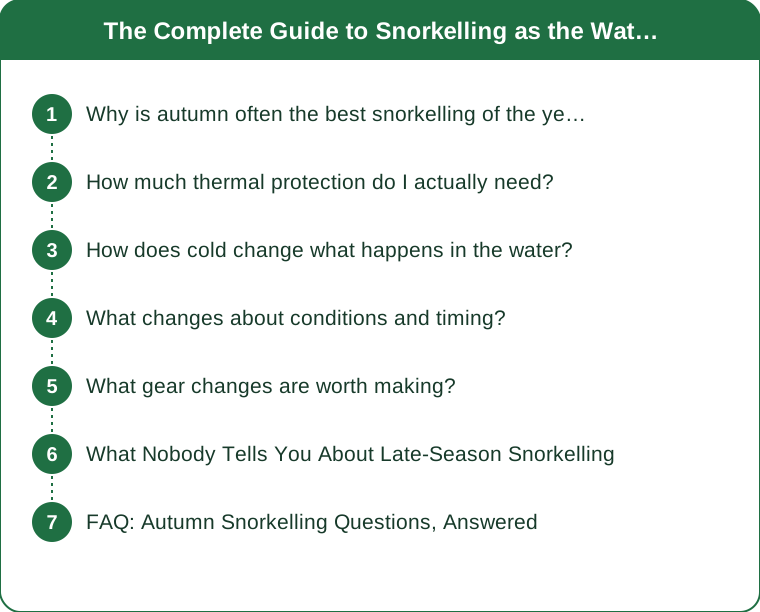
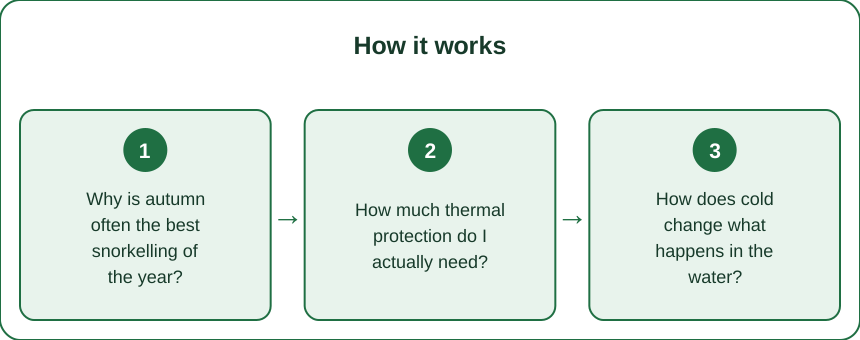
Why is autumn often the best snorkelling of the year?
Water clarity frequently improves as summer plankton blooms subside and as the water column stabilises, which can mean visibility considerably better than mid-summer.
Water temperature lags air temperature by weeks, so early autumn water is often still holding much of its summer warmth even as mornings turn cold. This is the one genuinely favourable part of the lag.
Marine life activity changes with the season, with some species more visible as water cools and as summer crowds and boat traffic reduce.
Sites are quieter, which matters more than people expect - fewer swimmers means less disturbed sediment and better visibility for everyone in the water.
Light angles are lower and warmer, which improves how everything looks underwater in the middle of the day rather than only at noon.
And access is easier - parking, launch points and popular coves that were unusable in August become straightforward.
The trade is that everything has less margin. Colder water, shorter days, more variable weather and fewer people around to notice a problem all compound, and they compound in the same direction. This is general information, not a substitute for local safety guidance or professional instruction.
How much thermal protection do I actually need?
Choose the wetsuit for the water temperature, not the air temperature. This is the single most common autumn error, made on warm sunny September days when the water has already dropped several degrees.
Check the actual water temperature before you go. Many coastal areas publish sea temperature data, and local dive shops and surf reports are reliable sources. Guessing from how it felt last month is not.
Snorkelling is colder than swimming at the same temperature, because you float still on the surface rather than generating heat through continuous effort. A wetsuit thickness that is comfortable for a vigorous swim may be inadequate for an hour of floating and looking down.
The head matters disproportionately. A significant proportion of heat loss occurs through the head and neck, and a neoprene hood or cap is the highest-value single item for extending a comfortable session. Many people who think they need a thicker suit actually need a hood.
Hands and feet go first and warn you last. Neoprene gloves and boots are cheap, and losing dexterity in your hands is a genuine safety issue when you need to adjust a mask or handle a fin.
Flushing matters as much as thickness. A poorly fitting suit that lets cold water circulate through it will be colder than a thinner suit that fits well. Check the neck, wrists and ankles.
And bring more warm layers than you think you need for afterwards - a changing robe, a hat, dry clothes and a hot drink. Getting cold after the session is where autumn snorkelling most often becomes genuinely unpleasant, and rewarming takes far longer than cooling did.
How does cold change what happens in the water?
Cold water shock is a real and rapid response to sudden immersion, producing an involuntary gasp and rapid breathing that can be dangerous if your face is in the water. Enter gradually and get your breathing under control before putting your face down.
This is the most important single piece of cold water knowledge and it applies at temperatures far above what people consider cold.
Manual dexterity degrades before you notice it. Cold hands lose fine motor control, which affects mask adjustment, fin straps and anything requiring grip - and it happens gradually enough that you may not register it.
Swim capacity reduces as muscles cool, meaning the return leg of a swim is harder than the outward one in a way that is not true in warm water. Plan routes accordingly and turn back earlier than feels necessary.
Judgement degrades with cooling too, which is the insidious part. The point at which you should get out arrives before you feel like getting out.
Shivering is a signal to exit, not to push on. By the time you are shivering meaningfully, you have been cooling for a while.
And rewarming should be gradual. A very hot shower immediately after significant cooling is not the best approach; warm dry layers, gentle movement and a warm drink are better. If you or someone with you shows confusion, slurred speech or stops shivering while still cold, that is a medical emergency - seek help immediately. This is general information, not medical advice.
What changes about conditions and timing?
Autumn weather changes faster and with less warning than summer weather, and a benign morning can become an unusable afternoon within a couple of hours.
Check the forecast, the wind direction and the swell forecast, not just the temperature. Wind against tide produces choppy conditions that make snorkelling both unpleasant and harder to exit from.
Daylight is contracting quickly. In late September you lose several minutes each day, and a session planned for summer daylight can end in dusk. Underwater light fades well before surface light does.
Plan to be out of the water at least ninety minutes before sunset, which gives margin for changing and for anything unexpected.
Sessions should be shorter. Where you might have snorkelled for ninety minutes in August, plan 30 to 45 minutes and get out while still comfortable.
Storm activity increases, and post-storm water is both murkier and more hazardous, with disturbed sediment, moved debris and altered currents. Give it a couple of days.
Check tides more carefully than in summer, since entry and exit points that were easy at one state of tide can be dangerous at another, and autumn tidal ranges can be large.
And never go alone in autumn, even at a site you know well in summer. Fewer people are around, response times are longer, and the consequences of a small problem are larger. Follow local safety guidance and consider joining an organised group.
What gear changes are worth making?
A hood or neoprene cap, first. It is the cheapest item on this list and it changes session length more than any other single purchase.
Gloves and boots, both for warmth and for grip on colder, wetter, more slippery entry points.
A brighter, more visible float or surface marker. Autumn light is flatter and greyer, boat traffic still exists, and being visible matters more when there are fewer people watching.
A well-fitted mask matters more in cold water because cold increases fogging. Treat the lens properly, and consider a low-volume mask which is easier to clear.
Anti-fog treatment becomes essential rather than optional, because the temperature difference between your face and the water is larger. Baby shampoo diluted heavily, or a commercial product, applied to a clean dry lens.
A changing robe and a large towel, which sound like comfort items and are actually thermal management. Getting warm quickly afterwards prevents the deep chill that ruins the rest of the day.
A hot drink in a flask, for the same reason and because it improves the whole experience considerably.
And a whistle attached to your float, which weighs nothing and is the simplest way to attract attention from the water. Follow local safety guidance for your area.
What Nobody Tells You About Late-Season Snorkelling
The air temperature will mislead you every time. A warm sunny October day with 15C water feels inviting from the beach and cold within four minutes. People consistently under-dress on sunny autumn days and over-dress on grey ones, when the water temperature is identical.
Your summer session length is not a guide. Cooling is cumulative and the last ten minutes of a session are the ones that produce the deep chill. Ending at 30 minutes when you feel fine is the whole skill.
Visibility can be spectacular and it changes how long you want to stay, which is exactly the trap. The best conditions of the year arriving alongside the shortest safe sessions is a genuinely difficult combination to manage.
Second sessions are much colder than first sessions. Going back in after a break, in a damp wetsuit, on a cool day, cools you far faster than the first entry did. If you plan two sessions, make the second one shorter.
Neoprene loses flexibility in the cold, so a suit that was easy to put on in August is a fight in October, especially on a cold beach with cold hands. Change somewhere sheltered and allow more time.
Rewarming takes far longer than cooling. People routinely underestimate this and drive home cold, which is both unpleasant and a genuine hazard if you are cold enough to be less alert behind the wheel.
Local knowledge is worth more in autumn than in summer, because seasonal current patterns, wind exposure and entry conditions change. A site you know only in July is functionally a new site in October.
And the season ends abruptly rather than gradually. There is usually a specific week when the water drops enough that everything changes, and it is worth knowing when that is where you swim rather than discovering it in the water.
FAQ: Autumn Snorkelling Questions, Answered
What water temperature is too cold to snorkel?
There is no single number, because it depends on your thermal protection, your experience, your session length and your acclimatisation. What matters more is matching your gear to the actual measured water temperature and shortening sessions as it drops. If in doubt, consult a local dive shop or club.
What wetsuit thickness do I need in autumn?
It depends entirely on your local water temperature, which varies enormously by region. Ask a local dive shop with knowledge of your specific area rather than following a general chart, and remember that snorkelling is colder than swimming at the same temperature.
Is a hood really necessary?
It is the highest-value single addition for cold water comfort, because significant heat is lost through the head and neck. Many people who think they need a thicker suit find a hood solves the problem.
How long should an autumn session be?
Shorter than summer - often 30 to 45 minutes rather than an hour or more - and you should get out while still comfortable rather than waiting for cold to tell you.
How do I stop my mask fogging in cold water?
Clean the lens thoroughly when new, then use an anti-fog treatment on a dry lens before each session. The temperature differential in autumn makes fogging much more likely than in summer.
Can I snorkel alone if I know the site well?
Snorkelling alone is not recommended at any time of year, and autumn increases the risks - fewer people around, faster-changing conditions, and colder water. Go with someone, tell someone where you are, and follow local safety guidance.
What are the warning signs I should get out?
Shivering, loss of dexterity in your hands, feeling unusually tired, difficulty maintaining your position, or any confusion. Get out at the first of these, not the third.
Is post-storm snorkelling safe?
Generally give it a couple of days. Water is murkier, debris has moved, entry points may have changed and currents can be altered. This is general information, not a substitute for local safety guidance.
TL;DR:
- Autumn often brings the clearest water and the quietest sites of the year.
- Choose thermal protection for the measured water temperature, never the air temperature.
- A hood or neoprene cap is the highest-value single item for extending comfortable sessions.
- Enter gradually to manage cold water shock, and get your breathing settled before your face goes in.
- Plan 30 to 45 minute sessions and get out while still comfortable.
- Cold degrades dexterity, swim capacity and judgement, in that order and without announcing itself.
- Never go alone, be out well before dusk, and bring more warm layers than you think you need.
The best snorkelling of the year comes with the least margin for error. This is general information, not a substitute for local safety guidance or professional instruction.
Keep Reading
This article is for general informational and styling purposes only. Fit, sizing, and product availability may vary.