The Complete Guide to Snorkeling Alone Safely
Quick Answer: Snorkeling alone is safer than it sounds if you control four things: site selection (shore-entry, sheltered, shallow, with a lifeguard or people in sight), a surface float you are attached to, a shore contact who knows your entry point and return time, and a hard rule against breath-hold diving. The single highest-value item is an inflatable snorkel vest or tow float — it removes drowning-through-fatigue, which is the mechanism behind the majority of snorkeling fatalities.
Nobody wants to organize a buddy for a Tuesday morning swim. So people go alone, quietly, and the standard advice — never snorkel alone — is repeated in a way that helps nobody who has already decided to.
Here is a more useful position. Solo snorkeling is a manageable risk, not a reckless one, provided you rebuild the safety margin the buddy was supposed to provide. That means adding redundancy elsewhere: at the site, on the surface, on the shore, and in the rules you set for yourself before you get in. This guide covers each in turn, plus the late-season conditions that catch people out this time of year.
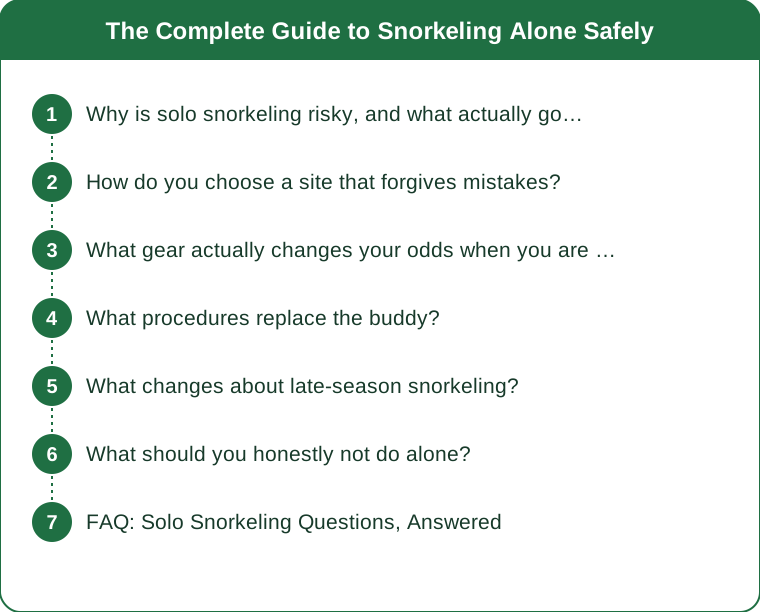
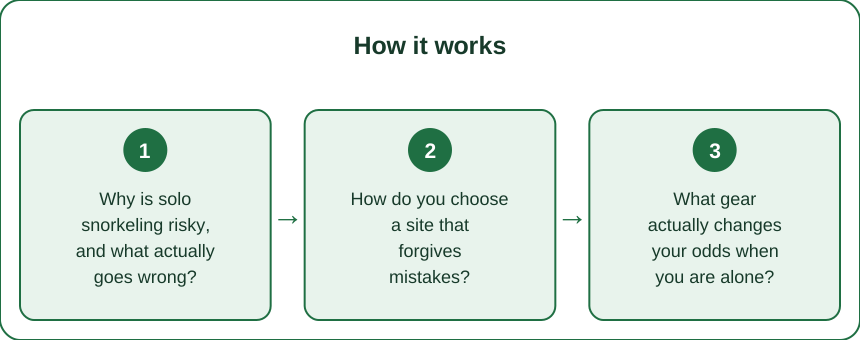
Why is solo snorkeling risky, and what actually goes wrong?
Understanding the mechanism is what makes the precautions make sense, so it is worth being specific.
The common assumption is that snorkeling accidents involve dramatic events — marine life, sudden squalls, equipment catastrophes. They rarely do. The dominant pattern in snorkeling fatalities is much quieter: a person becomes fatigued or distressed at the surface, is unable to keep their airway clear, and drowns within a short distance of shore.
The sequence usually looks like this. A snorkeler swims out further than intended, often because the current was assisting them without their noticing. They turn around and find the return swim considerably harder. Fatigue sets in. Breathing through a snorkel while working hard is harder than breathing in open air — the tube adds dead space and resistance. Anxiety raises breathing rate. Water enters the snorkel, gets partially inhaled, triggers coughing, which floods the tube again. The cycle escalates.
Every step in that chain is survivable if the person can simply stop and float. The reason it becomes fatal is that they cannot — either because they are not wearing flotation, or because panic prevents them from ditching the mask and rolling onto their back.
There is a second, less common but well-documented mechanism: shallow water blackout during breath-hold diving. A snorkeler hyperventilates before diving down, which lowers carbon dioxide and delays the urge to breathe without adding meaningful oxygen. They lose consciousness underwater with no warning. Alone, there is no one to bring them up.
A third factor is medical. Immersion and cold-water exposure place real load on the cardiovascular system, and a meaningful proportion of incidents involve underlying cardiac conditions. This is not a reason to avoid the water; it is a reason to know your own health status and not to push into cold water or hard swims without knowing it.
The through-line is that the buddy’s real function is not rescue — it is early detection. A buddy notices you struggling before it becomes an emergency. Every measure that follows is about replacing that early detection with something mechanical or procedural.
How do you choose a site that forgives mistakes?
Site selection does more for your safety than any other decision, and it is the one people put the least thought into because they go where the snorkeling is good rather than where the conditions are safe.
Shore entry over boat entry, always. A shore-entry site means the exit is continuously available. Anywhere you have to swim a long distance to reach the interesting water, the return swim is the risk.
Sheltered over exposed. Bays, lagoons, protected reef flats, and coves behind headlands. Open coastline exposes you to swell, chop, and rip currents. Look at a map before you go: a site that faces away from the prevailing wind will be dramatically calmer than one facing into it.
Shallow over deep. Water where you can stand, or nearly stand, converts an emergency into an inconvenience. Depths of one to four meters offer excellent snorkeling and a floor you can reach.
Lifeguarded, or at minimum populated. A lifeguarded beach reinstates the early-detection function the buddy was supposed to provide, and it is the closest thing to a genuine substitute. Failing that, a site where other people are in the water and can see you.
Known over novel. Solo is not the time to explore a site you have never seen. Snorkel a new location with someone else first, or at minimum walk the shoreline, watch the water for ten minutes, and talk to someone local about currents.
Check conditions before you commit. Wind speed and direction, tide state, swell height, and water temperature. As a rough rule, wind above about 12 knots produces chop that makes snorkel clearing tiring, and that is when solo stops being sensible. Entering on a rising tide near slack water gives you the calmest conditions and the most forgiving currents.
One local-knowledge point that matters everywhere: learn to identify a rip current before you enter. A channel of darker, calmer-looking water cutting through breaking waves, often with foam or sediment moving seaward, is a rip. If you end up in one, swim parallel to shore rather than against it, and float rather than fight.
What gear actually changes your odds when you are alone?
There is a large gap between the gear that improves your snorkeling and the gear that keeps you alive. Prioritize the second list.
Flotation — the single most important item
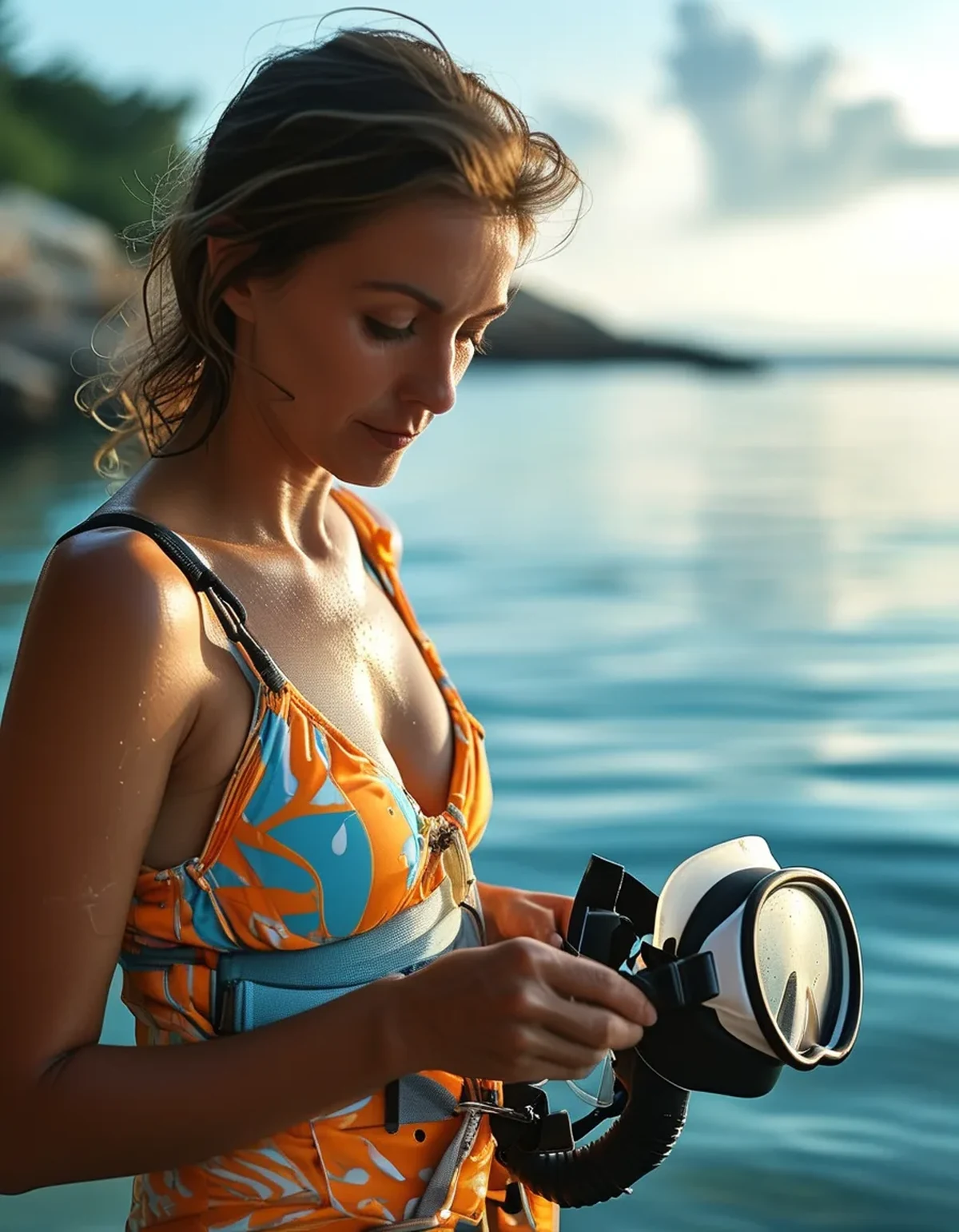
An inflatable snorkel vest or a tow float is the highest-value piece of equipment for a solo snorkeler. An inflatable vest sits flat and unobtrusive while you swim and can be inflated orally in seconds if you tire, cramp, or need to rest. A tow float — the bright inflatable buoy dry-bag swimmers use, attached by a waist leash — does two jobs at once: it gives you something to hold onto instantly, and it makes you visible to boats.
Visibility deserves emphasis. A snorkeler face-down in the water is close to invisible from a boat at any distance. A bright orange or pink float on the surface is visible from hundreds of meters.
Mask and snorkel
A well-fitting mask matters more when alone because a leaking mask creates exactly the low-grade stress that starts the fatigue cycle. Test the seal by placing the mask on your face without the strap and inhaling gently through your nose — it should hold on its own.
Use a conventional snorkel, not a full-face mask, when alone. Full-face masks have documented issues with carbon dioxide buildup in poorly designed models, they are far harder to clear if water enters, and they cannot be removed quickly in a panic. A standard snorkel with a splash guard and a purge valve is the safer choice by a wide margin.
Fins
Fins are safety equipment, not a comfort item. They let you make headway against a current that you could not swim against unaided. Full-foot fins over neoprene socks for warm water; open-heel with booties if there is any chance of walking over rock or coral.
Exposure protection
A rash guard or thin wetsuit does three things: sun protection over a back that is exposed for an hour or more, thermal protection that delays fatigue, and a small amount of positive buoyancy. Cold is a fatigue multiplier, and people consistently underestimate how much heat they lose over a 45-minute float even in water that felt pleasant on entry.
Signalling
A whistle attached to your vest or float. Cheap, weightless, and audible far beyond a shout. If you are somewhere genuinely remote, a small waterproof pouch with a phone becomes worth carrying.
What procedures replace the buddy?
Gear covers the physical failure modes. Procedure covers the rest, and this is where solo snorkelers get sloppy because none of it feels urgent on a calm morning.
Tell someone specific. Not a vague mention that you are going swimming. A named person, your exact entry point, and a return time — plus the instruction to call for help if they have not heard from you 30 minutes past it. This is the single procedure that converts a bad situation into a rescued one.
Set a hard turnaround point before you enter. Pick a physical landmark or a time, and honor it. The classic error is the one-way drift: the current pushes you gently along the coast while you look at fish, and you do not notice until the swim back is three times what you expected. Look up every few minutes and check your position against a fixed point on shore. This one habit prevents the most common solo emergency.
No breath-hold diving. Ever, when alone. This is non-negotiable. Shallow water blackout has no warning signs and no self-rescue. Whatever is on the bottom is not worth it, and the fact that you have done it a hundred times safely is not evidence that it is safe — it is the exact structure of the risk.
Enter and exit at the same point, and confirm the exit before you enter. Know how you are getting out, and check that it will still work at the tide state you will be returning in. Rocks that are easy to climb at high tide can be a two-meter drop at low.
Set a time limit and stick to it. Fatigue is cumulative and hard to feel while you are floating. Forty-five minutes to an hour is plenty for a solo session. Come out before you are tired, not when you are.
Rehearse the panic response. If something goes wrong, the sequence is: stop, roll onto your back, remove or push up the mask, inflate the vest or grab the float, breathe. Say it to yourself on the walk down to the water. Panic destroys improvisation, and a rehearsed sequence is the only thing that survives it.
What changes about late-season snorkeling?
This time of year has a specific trap, and it catches experienced people.
The water is still warm and the air is not. Sea temperature lags air temperature by several weeks, so late summer and early autumn often have the warmest water of the entire year — which is genuinely the best snorkeling of the season. The problem arrives on exit. Getting out of 24°C water into 16°C air with a breeze is a much sharper cold shock than midsummer, and it is where people get properly chilled.
Bring more than you think: a towel, a warm layer, and something hot to drink, all left where you can reach them quickly. Change immediately rather than standing around.
Conditions get less stable. Autumn brings more variable wind and more swell events, and the pleasant window can close faster than it does in midsummer. Check the forecast on the day rather than relying on the pattern from last week.
The light goes earlier. Underwater visibility depends heavily on sun angle. A site that was brilliant at 5pm in July is dim and much less pleasant at 5pm in September, and being in the water in fading light while alone is a bad combination. Move your sessions earlier in the day as the season turns.
Marine life shifts. Late season often brings better visibility as summer plankton blooms clear, and in many regions it is when larger pelagic species move through. It is genuinely a rewarding time to be in the water — which is exactly why it is worth being deliberate about the rest of it.
What should you honestly not do alone?
Being clear about the boundaries is what makes the rest defensible.
Do not snorkel alone if you are not a confident swimmer. Confident means comfortable treading water and floating on your back for several minutes in open water without touching the bottom, without a flotation aid, and without stress. If that description makes you uneasy, the answer is lessons and a buddy, not more gear.
Do not snorkel alone in current, surge, or surf. No amount of equipment compensates for water that is actively moving you.
Do not snorkel alone at night, in low visibility, or in unfamiliar water.
Do not snorkel alone after drinking. Alcohol impairs judgment, accelerates heat loss, and dulls the awareness of fatigue — the exact three things this entire framework depends on.
Do not snorkel alone if you have a cardiac condition, a seizure disorder, or any condition that could cause loss of consciousness, without clearing it with your doctor first. This is general information, not medical advice, and it is worth an actual conversation rather than a judgment call.
Do not free dive alone, which bears repeating because it is the rule most often broken by capable people who think it does not apply to them.
Beyond those, solo snorkeling in a sheltered, shallow, lifeguarded bay with a tow float and someone expecting you back is a reasonable activity that a great many people do safely every day. The precautions are not a lecture — they are the price of doing it on your own schedule.
FAQ: Solo Snorkeling Questions, Answered
Is a snorkel vest the same as a life jacket?
No. An inflatable snorkel vest is designed to be worn deflated while you swim and inflated when you need to rest — it is a fatigue solution, not a flotation device that will keep an unconscious person’s airway clear. A true life jacket does that but makes swimming face-down impractical. For solo snorkeling, the inflatable vest or a tow float is the right tool.
Should I use a full-face snorkel mask?
Not alone. Poorly designed models have documented carbon dioxide retention problems, they are difficult to clear if water gets in, and removing one quickly under stress is much harder than pulling a conventional mask off. A standard mask and snorkel is the safer configuration when nobody is watching you.
How far from shore is too far?
A practical rule: no further than you could comfortably swim back twice, in the conditions as they are at that moment. For most recreational snorkelers alone, that means staying within about 50 meters of an exit point, and considerably less if there is any wind or current. Distance from shore is where fatigue converts into an emergency.
What if I get a cramp?
Stop swimming, roll onto your back, and inflate your vest or take hold of your float — this is exactly the scenario the flotation exists for. Then stretch the affected muscle; for a calf cramp, grab the fin tip and pull it toward you with a straight leg. Rest until it fully releases before swimming back, and end the session there. Cramps are usually a signal about hydration, electrolytes, or cold, and all three get worse from that point on.
TL;DR:
- The real risk is fatigue at the surface, not marine life — and flotation removes most of it. Wear an inflatable snorkel vest or tow a bright float.
- Choose the site deliberately: shore entry, sheltered, shallow, lifeguarded or populated, and familiar.
- Tell a specific person your entry point and return time, set a turnaround landmark, check your position against shore every few minutes, and cap the session at 45 to 60 minutes.
- Never breath-hold dive alone. Never go alone in current, surf, low light, or after drinking.
- Late season means the warmest water of the year and the sharpest exit chill — bring a warm layer and move sessions earlier as the light goes.
Solo snorkeling is not the reckless act the blanket warnings imply, and it is not the casual one people treat it as either. Build the margin back in deliberately, and a Tuesday morning in a quiet bay becomes one of the better hours of the week.
Keep Reading
This article is for general informational and styling purposes only. Fit, sizing, and product availability may vary.