The Complete Guide to Snorkeling From Shore Versus From a Boat
Quick Answer: Shore snorkeling is cheaper, unlimited in time, and entirely self-managed - which means the entry and exit through the surf zone are yours to judge. Boat snorkeling puts you directly over better sites in deeper, calmer water with supervision, but on someone else’s schedule and with no shallow bail-out. Beginners are usually safer on a boat with a guide; confident swimmers with local knowledge get more water time from shore. The deciding factor is not skill in the water, it is skill at the edges.
Every snorkeling problem happens in the first five minutes or the last five.
The middle is the easy part.
What actually changes between shore and boat entry?
Almost everything about the risk profile, and very little about the swimming itself.
Shore entry means passing through the surf zone twice. The band where waves break is the most physically demanding and least predictable part of any shore snorkel. You cross it once on the way out, tired-free and organised, and once on the way back when you are cold and fatigued - and the return is where the problems happen.
Boat entry skips that entirely. You step or roll into open water that is usually calmer than the shoreline, with a fixed reference point and, on any reputable operation, someone counting heads.
Depth changes what a mistake costs. From shore you are typically in water shallow enough to stand up in for much of the swim, which is an enormous safety margin for a beginner. From a boat there is no standing up - if your mask floods and you panic, you are treading water in twenty metres.
Boats reach sites shore access cannot. Offshore reefs, walls, and channels are simply not reachable by swimming, and they are usually where the visibility and marine life are best.
Shore gives you unlimited time and repeat attempts. No departure time, no group pace, and the freedom to get out after ten minutes and go back in after a coffee. For learning, that repeatability is worth a great deal.
And the cost difference is not small. A shore snorkel is free after gear. A boat trip is a booked, priced, weather-dependent commitment.
The honest summary: shore is harder at the edges and easier in the middle. Boat is the reverse.
How do you read a shore entry before you get in?
By watching for a full ten minutes before touching the water - which almost nobody does and which prevents most incidents.
Watch the wave sets, not the individual waves. Waves arrive in groups with calmer gaps between them. Ten minutes of watching tells you how long the calm windows are and whether they are long enough to get through the break comfortably.
Find where the water is not breaking. A channel of deeper, darker, flatter water between breaking sections is the easiest exit route - but be aware that these channels are frequently where water is flowing back out to sea, which is helpful going out and hard coming back.
Identify your exit before you enter, and pick two. Conditions change while you are in the water, and having a second option removes the worst decision in snorkeling: being tired with only one way back.
Check the surface for rip currents. Look for a persistent lane of choppy, discoloured, or foamy water heading offshore, and for gaps in the incoming wave lines. If you are unsure, that is your answer - do not enter.
Ask someone local. Lifeguards, dive shops, and people who are clearly regulars know the site’s specific behaviour on the day far better than any general rule.
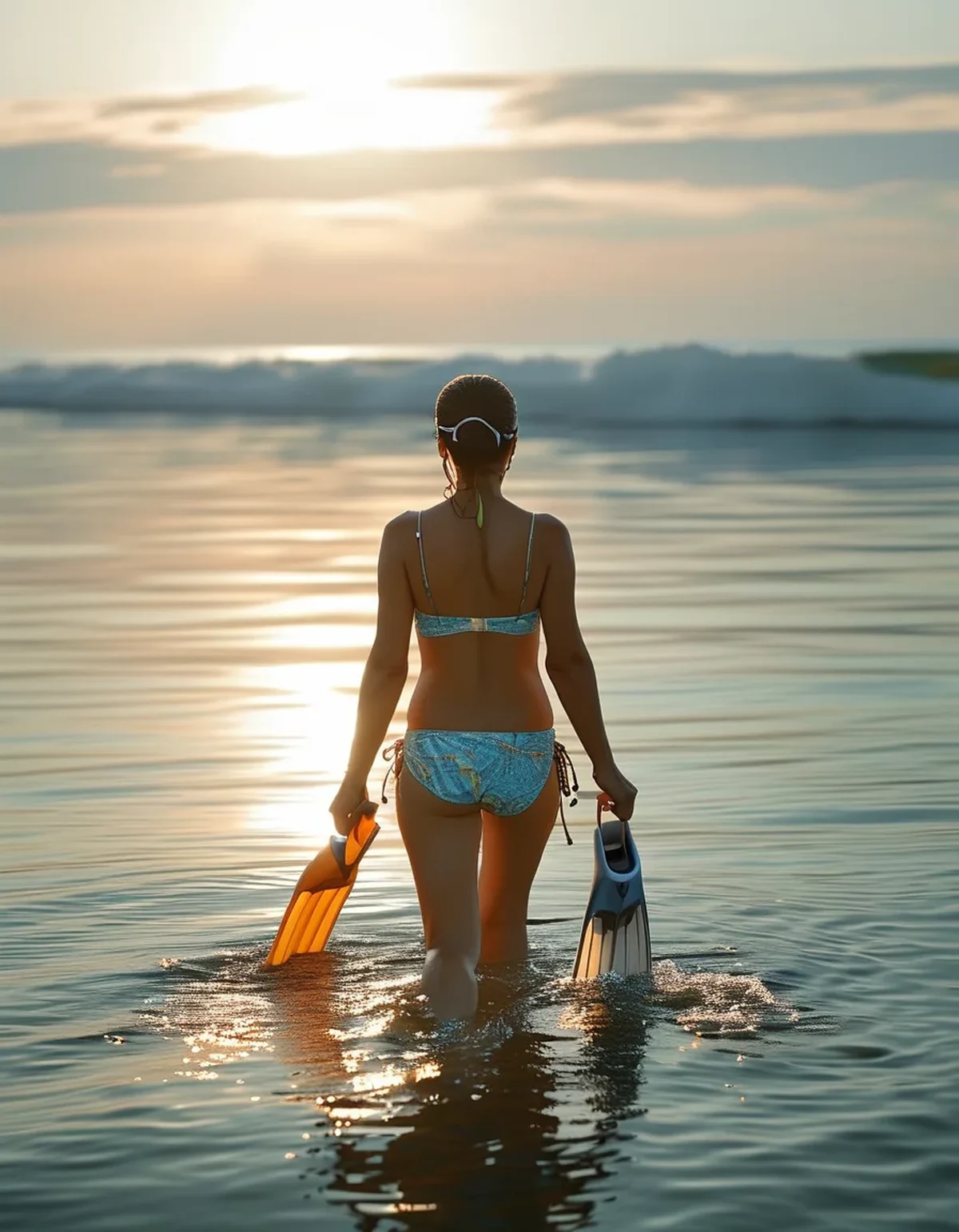
Enter with fins in hand, not on your feet. Walk backward into knee-deep water, then sit and put them on. Walking forward in fins in shallow surf is the single most common way people fall on entry.
And enter with a full mask and snorkel already on. Fumbling with gear while waves hit you is how beginners get overwhelmed thirty seconds into a swim.
What does a good boat snorkel day look like?
Structured, briefed, and slower than you expect - and the briefing is the part that matters.
Listen to the entry briefing even if you have done it before. Every boat has its own procedure for entry method, exit ladder, current direction, and the signal to return. The current direction briefing is the important one - you almost always want to swim into the current first and drift back.
Get in early rather than last. The first people in get the calmest water and the most time, and they are not queuing at the ladder at the end.
Do a mask and snorkel check at the surface before swimming off. Thirty seconds of floating next to the boat confirms your seal, your fin straps, and your breathing rhythm. Discovering a leaking mask two hundred metres away is a different problem entirely.
Keep the boat in view and check every couple of minutes. Drift happens gradually and invisibly. The most common boat-snorkel emergency is simply ending up further away than intended, usually while looking down at something interesting.
Know the ladder procedure before you need it. Fins off or on, one person at a time, hold with both hands. The ladder in a swell is the most likely place to get hurt on the whole trip.
Do not be the last one back. Tired people make poor decisions, and a boat waiting on one swimmer is a pressured situation for everybody.
And accept the schedule. Boat trips run to timings driven by tides, other groups, and weather. The trade for effortless access is that you do not decide when it ends.

How does gear differ between the two?
Less than people think, with three genuine exceptions - flotation, protection, and what you can carry.
A flotation aid matters far more on a boat trip. In deep water with no standing option, a snorkel vest or a small inflatable buoy converts a potential crisis into a pause. Many operators require one, and the ones that do not should be asked why.
A surface marker or dive flag matters far more from shore. Boat traffic near shore is the real hazard, and a small brightly coloured float towed on a line makes you visible and gives you something to rest on. It is the highest-value twenty pounds in shore snorkeling.
Footwear differs completely. Shore entries over rock, coral rubble, or hot sand call for water shoes and open-heel fins that fit over them. Boat entries suit full-foot fins, which are lighter and simpler with nothing to walk on.
Exposure protection scales with time in the water. Shore snorkeling often means longer sessions, and cooling happens quietly - a rash guard or thin wetsuit top extends comfortable time enormously and doubles as sun protection.
Defog and a spare mask strap are worth carrying on both. A snapped strap ends a boat trip you paid for, and a fogging mask ruins any session. Both weigh nothing.
And carry less from shore than you think you need. Anything you bring must be left on a beach or towed. A dry bag clipped to a tow float solves this and is the setup most experienced shore snorkelers converge on.
Nothing about the mask, snorkel, or fin fit changes - a well-fitting mask is equally essential either way, and it remains the single piece of gear worth spending on.
How do you build up from beginner to confident?
In a specific order, and the order is what most people get wrong by starting at the reef.
Start in a pool or a flat sheltered bay. Practise clearing a flooded mask, clearing the snorkel, and floating calmly face-down with your hands still. These three skills are the whole foundation and they should be automatic before you go anywhere interesting.
Then do a shallow shore snorkel on a calm day. Water you can stand up in, no swell, no current, and a short session. The goal is not to see anything - it is to get comfortable with the edges.
Then take a guided boat trip. With the basics solid, a guided trip in deep calm water is both safer and far more rewarding than fighting a shore entry at an unfamiliar site.
Then combine: unfamiliar shore sites, longer sessions, and more challenging conditions - always with a buddy and always with a tow float.
Learn to recognise your own cold and fatigue signals. Shivering, clumsiness, and irritability are all late signs. Turn around at the first hint rather than the third - and remember that the return trip is often the harder one.
Practise the exit specifically. Most people practise swimming and never practise getting out. Timing a shore exit with a wave set is a skill, and it is the one you will need when you are most tired.
And build the habit of the ten-minute watch. Experienced snorkelers do it at every site, every time, including sites they know - because the site is different every day.
7 Things Nobody Tells You About Shore and Boat Snorkeling
The return trip is nearly always harder. You are colder, more tired, and often swimming against whatever helped you on the way out. Budget half your energy for getting back, not a third.
Seasickness is a real factor in boat snorkeling and hits before you get in the water. Anchored boats over reefs roll significantly. If you are prone to it, sit outside, watch the horizon, and take remedies well before departure rather than when you feel it starting.
Shore sites are best at the start of the day, and it is not about crowds. Wind typically builds through the day in coastal areas, and morning water is calmer and clearer. The same site can be excellent at 8am and unusable at 2pm.
You lose heat far faster than you notice. Water conducts heat away many times faster than air, and floating still generates almost no warmth. A session that felt fine at thirty minutes can leave you shivering hard at forty.
Sunburn on your back is close to guaranteed without a top. You are floating face-down for an hour with water amplifying the exposure, and sunscreen on your back is both hard to apply and bad for reefs. A rash guard solves both problems at once.
Boat operators vary enormously and price does not predict quality. Look for head counts on entry and exit, a proper briefing, flotation available, and a guide actually in the water. Ask how many people are in the water per guide - it is the most revealing question you can ask.
And the best snorkeling is often shallower than you think. Light drops off quickly with depth, so colour and life are frequently richest in three to six metres. A boat that takes you somewhere deep is not automatically taking you somewhere better - which is the strongest argument for a good shore site you know well.
This is general safety information, not a substitute for local knowledge or formal instruction. Conditions vary enormously by site and day.
TL;DR:
- Shore snorkeling is hard at the edges, easy in the middle. The surf zone entry and exit are the whole risk.
- Boat snorkeling is easy at the edges, less forgiving in the middle - no standing up, so flotation and buddy awareness matter more.
- Beginners should go boat-with-guide first, then build shore skills on calm, shallow, familiar sites.
- Watch any shore site for ten minutes before entering, identify two exits, and enter backward with fins in hand.
- Tow float from shore, flotation aid from a boat, rash guard for both.
- Budget half your energy for the return and turn around at the first sign of cold or fatigue.
Next calm morning, go and watch a shore site for ten minutes without entering. The habit is free, and it is what separates people who snorkel comfortably from people who get caught out.
Keep Reading
This article is for general informational and styling purposes only. Fit, sizing, and product availability may vary.