The Complete Guide to Snorkeling With Kids Without Losing Track of Anyone
Quick Answer: The core problem is not swimming ability, it is visibility and drift. A child face-down in the water is nearly invisible from thirty feet, they move downwind faster than adults because they float higher, and they surface without signaling. Fix it with bright high-contrast gear, a hard rule of one adult per one or two kids, a fixed shore reference everyone checks, and a buddy structure that gets checked on a timer rather than by feeling.
Most family snorkeling near-misses are not dramatic. They are the ninety seconds where you look up and cannot immediately find the smaller of your two kids, and then you can, and your heart rate takes twenty minutes to come back down.
Why do kids get separated so much faster than adults?
Three things stack, and none of them are about swimming skill.
They float higher and catch more wind. A child has proportionally more body above the waterline and much less mass to resist it. In a light breeze, a floating child drifts noticeably faster than a floating adult in the same water. Over ten minutes of face-down looking at fish, a fifteen-knot breeze can move a small child well over a hundred feet while you moved forty.
They are almost invisible face-down. A snorkeler on the surface presents a few inches of snorkel tip and a sliver of back. From water level — which is where your eyes are — a small child at thirty feet disappears completely behind a one-foot swell. You are not looking across a flat pool; you are looking across a textured surface from six inches above it.
They do not signal when they surface. An adult who comes up looks around and re-orients. A child comes up, wipes their mask, says something to nobody, and goes back down. There is no natural check-in built into how kids swim, which means every check has to come from you.
And attention is genuinely absorbing. A child watching a fish is fully committed to watching that fish, with no background process tracking position, depth, distance from shore, or where the adults are. That is not carelessness; that is how attention works at that age, and the plan has to assume it rather than correct it.
What is the right adult-to-child ratio?
One adult per one or two children, with a named assignment, and it is stricter than most families run.
The critical word is named. Two adults and three kids with no assignment is the most common failure mode there is, because each adult assumes the other is watching the middle child. Say it out loud before anyone gets in: “I have Maya and Sam, you have Jonah.” Ten seconds, and it eliminates the diffusion-of-responsibility gap entirely.
The ratios that actually work:
- Strong swimmer, comfortable with the mask, 10+: one adult can manage two.
- Any child under about eight, or any child new to snorkeling: one adult, one child, full stop.
- A child who is nervous, or in any conditions with chop or current: one adult, one child, within arm’s reach.
The adult’s job is watching, not snorkeling. This is the part families resist and it is the part that matters. An adult with their own face in the water is not supervising — they are also snorkeling, near a child. If you want to actually look at the reef, trade off in shifts so that one adult is always heads-up.
And designate a shore person for larger groups. Someone on the beach with a clear view, counting heads on a schedule, catches drift long before anyone in the water does, because they can see the whole spread at once from a raised position.
What gear actually reduces the risk?
Visibility gear and flotation, in that order. The rest is comfort.
Flotation is non-negotiable for kids. A snorkel vest or a bright rashguard-style flotation top does two enormous things: it keeps a tired child on the surface without effort, and it makes them dramatically more visible. Choose one you can inflate and deflate, so a confident child can swim down a little and still float up.
Bright means orange, yellow, or hot pink — not blue. Blue disappears in water. This applies to the vest, the rashguard, the snorkel tip, and the fins. The snorkel tip is the part you will actually be scanning for, since it is the only thing above the surface, so a fluorescent tip is worth more than it costs.
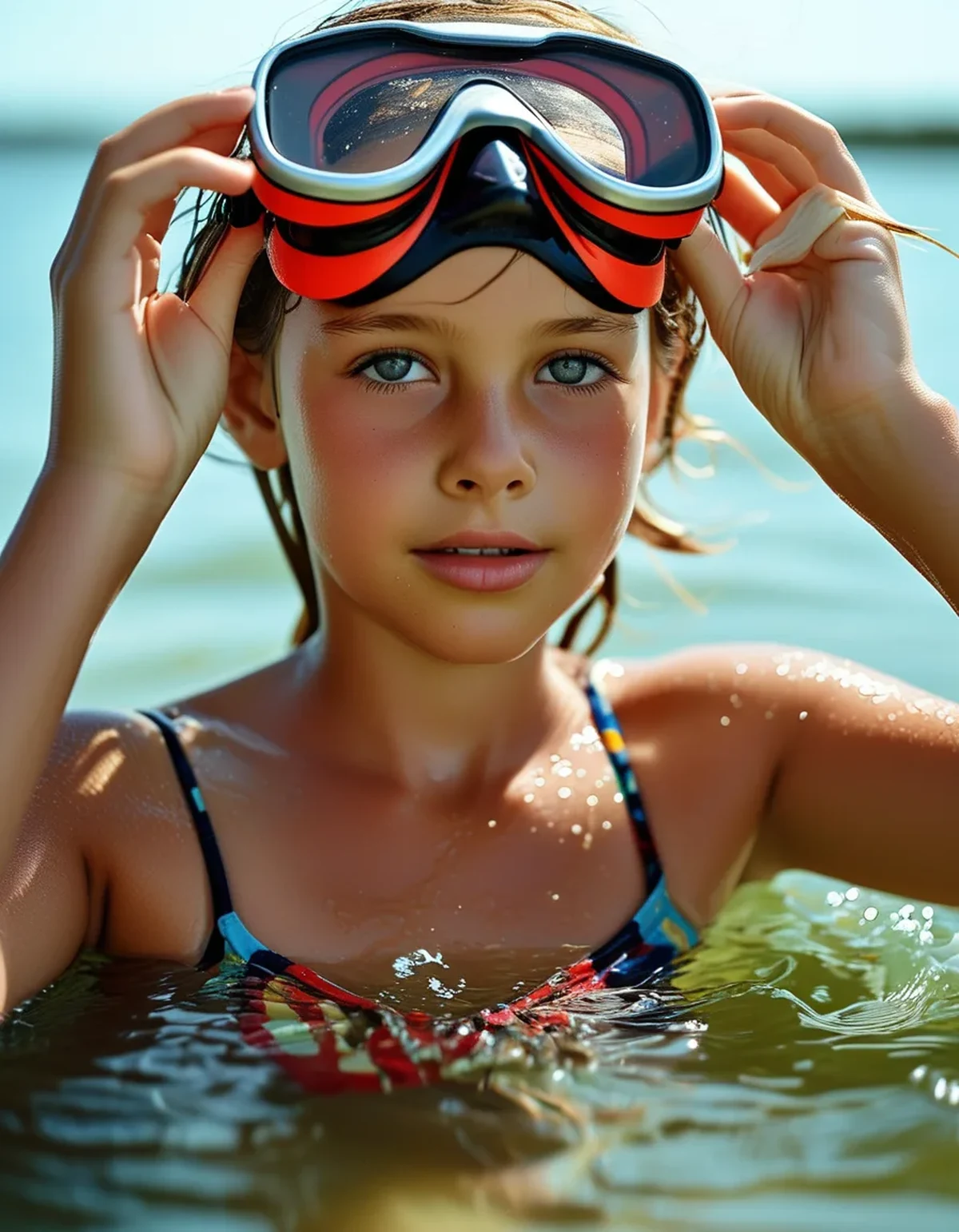
Skip full-face masks for children. They are appealing because they seem easier, and they carry documented concerns around carbon dioxide buildup in poorly designed models, they are harder to clear if water gets in, and they cannot be removed quickly in a panic. A traditional mask and separate snorkel is the safer configuration, and it is what dive professionals recommend for kids.
Fins are optional and often counterproductive. They add speed a child does not need and make drift faster. For young kids in shallow calm water, no fins is frequently the better call.
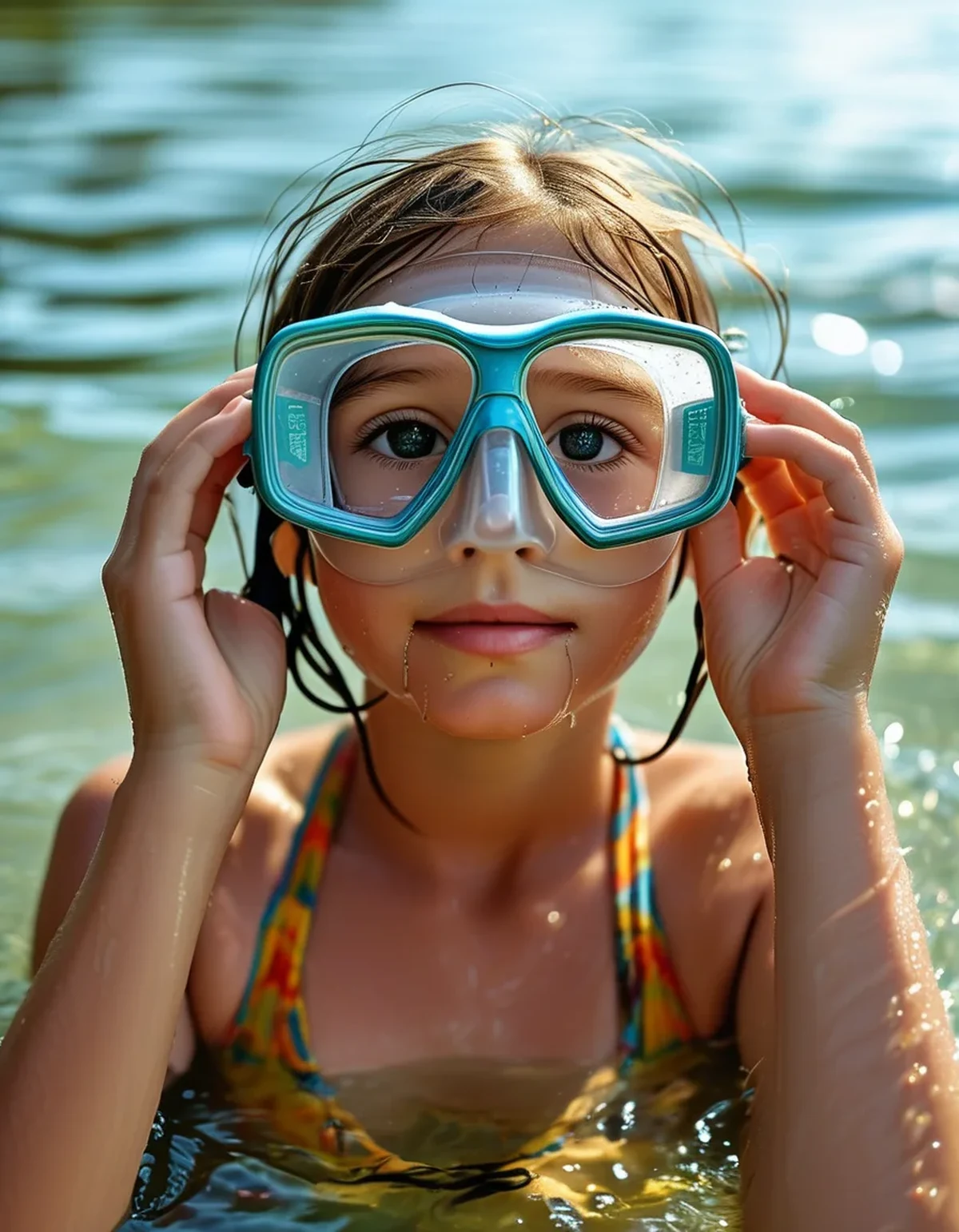
Get the mask fit right or nothing else matters. Hold it to the face without the strap and breathe in gently through the nose — it should stick. A leaking mask is the number one reason kids stop enjoying it, and a child fighting their mask is a child not paying attention to anything else.
And one adult carries a whistle. Voices do not travel across water nearly as well as people assume, and a whistle does.
How should you structure the actual swim?
Around a fixed reference and a timer, not around vibes.
Pick a shore reference before you get in. Not a boat, not an umbrella that might move — a building, a rock formation, a tree line. Everyone looks at it and names it out loud. This is what tells you whether you have drifted, and it works even when you cannot judge distance well from water level.
Enter upwind or up-current. You will drift as you swim, so drift toward your exit rather than away from it. The classic error is swimming out with the current because it feels easy, then discovering the return leg is a genuine effort with a tired eight-year-old.
Set a check interval and hold to it. Every two or three minutes, heads up, count everyone, check the shore reference. Two minutes feels absurdly frequent for about ten minutes and then it stops feeling like anything. Doing it on a rhythm rather than when you happen to think of it is the entire point, because you will stop thinking of it once something interesting swims past.
Define the boundary in objects, not distances. “Stay between me and the yellow buoy” works. “Don’t go too far” does not. Kids cannot estimate distance in water, and neither can you as reliably as you think.
Agree on signals on the beach. Thumbs up for fine, waving one arm for come here, tapping the top of the head for I am okay. Practice them in knee-deep water before it matters. The signal that matters most is the one for “I want to get out,” and it needs to be one a child will actually use without feeling like they ruined the outing.
Keep it short. Twenty to thirty minutes is a full session for most kids. Ending while they still want more is what makes them want to go again.
What are the conditions you should not go out in?
The read takes five minutes from shore and it is the highest-value thing in this guide.
Watch the water for a full five minutes before anyone changes. Not a glance. Sets of waves come in groups, and the third or fourth set is often noticeably larger than the first.
Do not go with kids if:
- There is visible current. Watch a piece of floating weed or foam. If it tracks steadily along or away from shore, that is current, and a child cannot swim against even a modest one.
- The surface is choppy. Chop makes snorkels ship water, makes masks flood, and — critically — makes a small child invisible from thirty feet.
- Visibility underwater is poor. Cloudy water means you cannot see your child even when they are close, and it makes the whole experience less rewarding anyway.
- There is any surf breaking on the entry. Entry and exit through breaking waves is where injuries happen, and it is much harder for small bodies.
- You cannot identify an easy exit. You need somewhere to get out that does not involve climbing rocks, and ideally two of them.
Late summer adds a specific one: water is at its warmest and most inviting in August and early September, and that is also when many locations see the most boat traffic and the most variable afternoon wind. Morning is consistently calmer than afternoon in most coastal areas, and it is worth the earlier start.
And learn the local flag system wherever you are. Warning flags exist because someone drowned there, and they are the cheapest information available.
What do you do when something goes wrong?
Have the answers decided in advance, because none of these are the moment for improvisation.
If a child panics: get to them, get them vertical, and get the mask off their face. A flooded or fogged mask is the most common trigger and removing it resolves the panic immediately. Inflate their vest, let them hold onto you, and go back to shore. Do not try to talk them through continuing.
If you cannot find a child: call out immediately and get everyone heads-up before you start swimming. Check downwind and down-current first — that is where they will be, essentially always. Get the shore person scanning from height. Do not spend thirty seconds telling yourself it is fine; the cost of an unnecessary alarm is zero and the cost of a delayed one is not.
If a snorkel keeps flooding: it is usually chop plus a tube that is too long for the child, or the child swimming with their head at too shallow an angle. Move to calmer water and check the mouthpiece seal.
If someone is tired: flip onto the back, inflate the vest, and rest. Fatigue is the most common precursor to a real problem, and the correct response to a tired kid is always ending the session, not one more look at the reef.
If there is current pulling you away from shore: swim parallel to the shore, not against the pull. This is the standard rip current response and it is worth teaching kids on the beach in words they will remember. Do not fight it directly — you will lose, and adults have drowned doing exactly that.
And the rule that prevents most of this: end early. Thirty good minutes with everyone happy is a successful outing. Pushing to fifty because conditions are nice is how tired kids and drifting kids happen.
FAQ: Snorkeling With Kids, Answered
What age can kids start snorkeling?
Comfort matters more than age. A child who is relaxed floating face-down with a mask, can clear water from their mouth without alarm, and follows instruction in the water is ready — that is often around five or six, sometimes considerably later. Practice in a pool first, which removes every variable except the gear.
Do they need to be strong swimmers?
With a flotation vest and an adult within arm’s reach, a confident non-swimmer can snorkel safely in calm shallow water. Without a vest, they need to be a genuinely competent swimmer, because the day the mask floods is the day the swimming matters. The vest is the difference between a manageable problem and a serious one.
How do I stop their mask fogging?
Same as for adults, and it matters more for kids because a fogged mask is the main thing that ends the session. Scrub a new mask’s lens with a drop of non-gel toothpaste before its first use to strip the manufacturing film, then use a defog solution or a little saliva before each swim, rinse lightly, and do not touch the inside of the lens with your fingers afterward.
TL;DR:
- Kids drift faster and are nearly invisible face-down, so separation is a visibility problem, not a swimming problem
- Assign each adult to a named child out loud before entry, and keep one adult heads-up at all times
- Bright orange or yellow vest, bright snorkel tip, traditional mask over full-face, and often no fins
- Pick a fixed shore reference, enter upwind, and check the group on a two-to-three minute timer
- Read the water for five full minutes first, go in the morning, and end while everyone still wants more
None of this is complicated and most of it happens on the beach before anyone gets wet. The ten minutes of setup is what turns the afternoon into the one everyone remembers for the right reason.
Keep Reading
This article is for general informational and styling purposes only. Fit, sizing, and product availability may vary.